About five decades ago, I lived in Haiti for a year and a half. I was trying to figure out how the marketplaces—which, then as now, tie the country together economically—actually worked. ~ Sidney Mintz (2010).
Showing posts with label Haiti. Show all posts
Showing posts with label Haiti. Show all posts
Monday, June 2, 2025
Report on Haiti
Mintz, Sidney W., “Report on Haiti” (Paper), 1959.

Wednesday, July 3, 2024
Ethnicity, Nationalism and Politics: the Haitian Case
Manigat, Leslie F., “Ethnicity, Nationalism and Politics: the Haitian Case”, St. Augustine, Trinidad: Institute of International Relations, n.d.
Leslie François Saint Roc Manigat was a Haitian politician who was elected as President of Haiti in a tightly controlled military held election in January 1988.[2] He served as President for only a few months, from February 1988 to June 1988, before being ousted by the military in a coup d'état. Leslie Manigat was a professor at the prestigious l'Université de Paris-VIII Vincennes, where he gave courses on World History. He also published articles on education in various Haitian newspapers: Le Nouvelliste, La Phalange, and Le Matin.
Friday, July 28, 2023
Bibliography on Haiti: English and Creole Items, Paper # 6
Lawless, Robert, (compiler) Bibliography on Haiti: English and Creole Items, Paper # 6, Gainesville Fla.: Center for Latin American Studies, June 1985.
From the Introduction:
Table of Contents:
From the Introduction:
Since 1977 when they began arriving in Florida in significant numbers, Haitian immigrants have had an impact on the American conscience rarely matched by the migrations of any other group. The heartrending spectacle in 1981 of 33 Haitians drowning after their 25-foot homemade boat capsized within 50 yards of the shores of the affluent community of Hillsboro Beach, Florida, was followed on network televisión by other stories of the tragedies of the Haitian boat people. The publicity resulted in positive action by many U.S. civic groups.
Table of Contents:
Topic:
Introduction
1. Agriculture
2. Art
3. Bibliographies
4. Demography
5. Economics
6. Education
7. Family
8. Fiction
9. Health
10. History
11. Humanities
12. Independence
13. Languages
14. Literature
15. Migration
16. Occupation
17. Politics
18. Popular
19. Relations with United States
20. Religion
21. Sociocultural
22. Urbanism
23. General
Author Index.
Sunday, July 16, 2023
Les origines des esclaves des Antilles: suite [Extrait du "Bulletin de l'Institut français d'Afrique noire". T. 25, B. N°s 3-4, 1963]
Houdaille, Jacques, R. Massio, et G. Debien, Les origines des esclaves des Antilles: suite, Extrait du "Bulletin de l'Institut français d'Afrique noire". T. 25, B. N°s 3-4, 1963.
10. A la Guadeloupe
11. Aux Gommiers (Pointe - à - Pitre , 1782)
12. Au Lamentin (1786)
13. A la Baie Mahault (1789)
14. Aux Saintes – Terre de Haut (1789)
15. A la Martinique – L'Anse à l'âne (1767)
16. A Saint Domingue – Registres paroissiaux de Jacmel, des Cayes et de Fond-des-Négres
17. Au Fond-Ferrier (1784)
18. Équipages de pêche au Cap en 1792
19. A la Raque des Sources (1757)
20. Chez le Colon Boissieu, A Fel (1767)
21. Chez le Colon Maphaud, A Fel (1767)
22. A La Guillaumone (1767)
23. Les opérations d’un Mulâtre (1767)
24. Chirurgien et Colon (1767) – a la Guillaumone
25. Chirurgien et Petit Colon (1767)
26. Société Castez-Noland (1767)
27. A la Crête-a-Palmiste a fel (1769)
28. A la Gosseline, chez une “Négresse libre” (1787)
29. Ferme des Esclaves Galan a Baudoin-Desmarattes (1767)
30. Bail d’Esclaves aux Gonaïves (1782)
31. Entre Mulâtres Libres (1786)
Sunday, March 5, 2023
Les origines des esclaves des Antilles: suite [Extrait du "Bulletin de l'Institut français d'Afrique noire". T. 24, B. N°s 1-2, 1963]
Richard, R., et G. Debien, Les origines des esclaves des Antilles: suite, Extrait du "Bulletin de l'Institut français d'Afrique noire". T. 24, B. N°s 1-2, 1963.
Translation:
La Composition Ethnique de Trois Ateliers du Quartier de Nippes (Saint Domingue)
Les trois listes d'esclaves ici présentées ont ceci de commun qu'elles viennent du même quartier, celui de Nippes et l'Anse-à-Veau sur la côte septentrionale de la presqu'île du sud de Saint Domingue et qu'elles sont de la même période du XVIIIe siecle, des années 1756 - 1767. Deux de ces ateliers sont des ateliers d'indigoteries; le troisième est celui d'une sucrerie; indigoteries d'importance moyenne et petite sucrerie. Ces listes sont extraites d'inventaires généraux de plantations trouvés dans le fonds des notaires de Saint-Domingue aux Archives Nationales, section Outre-Mer (27, rue Oudinot, Paris). Malheureusement elles sont isolées. On n'aura chaque fois qu'une coupe. Plusieurs inventaires de la même plantation eussent permis de présenter une image en mouvement, comme a pu le faire M. Teychenié pour l'indigoterie Belin des Marais, de la Petite-Rivière de l'Artibonite.
Translation:
The Ethnic Composition of Three Workshops in the Nippes District (Haiti)
The three lists of slaves presented here have in common that they come from the same district, that of Nippes and Anse-à-Veau on the northern coast of the southern peninsula of Santo Domingo and that they are from the same period of the 18th century, from the years 1756 - 1767. Two of these workshops are indigo workshops; the third is that of a sugar estate; indigo factories of medium importance and small sugar estates. These lists are taken from general inventories of plantations found in the Saint-Domingue notary collection at the National Archives, Overseas section (27, rue Oudinot, Paris). Unfortunately they are isolated. We will only have one cut each time. Several inventories of the same plantation would have made it possible to present a moving image, as Mr. Teychenié was able to do for the indigo factory Belin des Marais, de la Petite-Rivière de l'Artibonite.
Wednesday, March 1, 2023
L'alternative democratique, nationale, progressive: bulletin de reflexion, d'orientation et de liaison du Regroupement des démocrates nationaux-progressistes d'Haiti (R.D.N.P.), Volume 1, Nos. 1, 2
Rassemblement des démocrates nationaux-progressistes d'Haiti, L'alternative democratique, nationale, progressive: bulletin de reflexion, d'orientation et de liaison du Regroupement des démocrates nationaux-progressistes d'Haiti (R.D.N.P.), Volume 1, No. 1 – Octobre – Decembre 1979, No. 2 – Janvier – Mars 1980, Caracas, Venezuela: R.D.N.P.
Translation:
Le Rassemblement des démocrates nationaux progressistes (RDNP) est un parti politique haïtien membre de l'Organisation démocrate-chrétienne d'Amérique1, fondé en exil en 1979 par Leslie Manigat. Sa présidente est Mirlande Manigat, qui dirige à nouveau le parti depuis l’assassinat de Éric Jean Baptiste le 28 octobre 2022.
Translation:
The Rally of Progressive National Democrats (RDNP) is a Haitian political party member of the Christian Democratic Organization of America, founded in exile in 1979 by Leslie Manigat. Its president is Mirlande Manigat, who has again led the party since the assassination of Éric Jean Baptiste on October 28, 2022.
L'alternative democratique, nationale, progressive: bulletin de reflexion, d'orientation et de liaison du Rassemblement des démocrates nationaux-progressistes d'Haiti (R.D.N.P.), Volume 1, No. 3
Rassemblement des démocrates nationaux-progressistes d'Haiti, L'alternative democratique, nationale, progressive: bulletin de reflexion, d'orientation et de liaison du Rassemblement des démocrates nationaux-progressistes d'Haiti (R.D.N.P.), Volume 1, No. 3 – Avril – Juin 1980, Caracas, Venezuela: R.D.N.P.
Translation:
Le Rassemblement des démocrates nationaux progressistes (RDNP) est un parti politique haïtien membre de l'Organisation démocrate-chrétienne d'Amérique, fondé en exil en 1979 par Leslie Manigat. Sa présidente est Mirlande Manigat, qui dirige à nouveau le parti depuis l’assassinat de Éric Jean Baptiste le 28 octobre 2022.
Translation:
The Rally of Progressive National Democrats (RDNP) is a Haitian political party member of the Christian Democratic Organization of America, founded in exile in 1979 by Leslie Manigat. Its president is Mirlande Manigat, who has again led the party since the assassination of Éric Jean Baptiste on October 28, 2022.
Sunday, February 26, 2023
Bottom-up Development in Haiti
Maguire, Robert, Bottom-up Development in Haiti, Second Edition, Rosslyn, VA.: Inter-American Foundation, April, 1981.
Available online.
Available online.
Dr. Maguire retired in 2017 as a full-time professor of International Development Studies at the Elliott School of International Affairs, where he also directed the Latin American & Hemispheric Studies Program, the Brazil Initiative, and the Focus-on-Haiti Initiative. At the Elliott School, he created and taught a graduate seminar called, “Bottom-Up Development,” which he has continued to teach after retiring. Between 2001 and 2011, he taught at Trinity Washington University where he created and directed its International Affairs Program. From 1979 to 1999, he served as the Representative for Haiti and the Caribbean of the Inter-American Foundation, a U.S. government agency that supports grassroots, bottom-up development initiatives undertaken by local, community-based organizations. In 2000, he worked at the U.S. Department of State as Special Haiti Advisor. As a respected expert on Haiti and US-Haiti policy, he advises numerous U.S. Executive Branch agencies, the U.S. Congress, and various international organizations.
Saturday, February 4, 2023
Les Origines des Esclaves Antillais: V
Houdaille, Jacques, Les origines des esclaves antillais: V, Extrait du Bulletin de l'Institut français d'Afrique noire, sér. B, nos. 3-4 (1964).
A Saint-Domingue:
A Saint-Domingue:
Aujourd'hui, deux groupes d'analyses, d'origine tout à fait différent. Par leur comparaison entre eux ces groupes montrent des des parallèles, des contrastes aussi. Mais on n'a pas tenté les rapprochements. Ils seront faits au moment de la conclusion générale, la toute dernière. On aura donc: 1o l'analyse de 10 listes d'esclaves, de plantations: 8 de l'Ouest, 2 du Sud, des années 1796 et 1797; 2o le relevé de tous les baptêmes, sépultures et mariages de libres d'origine africaine précise, trouvés dans les registres paroissiaux de Port-au-Prince, de la Croix-des-Bouquets, de Léogane, du Petit-Goave, du Grand-Goave, de Baynet, d'Aquin, de Saint-Louis du Sud, de Limonade, du Port-de-Paix et de Santo-Domingo. C'est une occasion toute fortuite qui nous a permis d'examiner un des registre de l'"Administration anglaise à Saint-Domingue" qui correspondent aux années 1794-1798 où l'armée britannique occupa le Sud et l'Ouest de l'île. Dans ces recueils il s'agit surtout des biens de colons absents, mis sous séquestre, puis donnés à ferme par adjudication. Ces fermes commençaient naturellement par un inventaire général. Ces inventaires décrivent sommairement l'état de la plantation, présentent la liste des esclaves. L'ordre n'est pas toujours le même, n'est pas plus systématique que dans les inventaires d'avant la Revolution. Au reste ce sont les mêmes notaires qu'autrefois qui les dressent. Ont été retenues les listes qui précisaient l'origine des esclaves. Neuf des dix listes ont été prises dans le premier registre. Seul l'inventaire de la sucrerie Blanchard vient du 2e volume.
Today, two groups of analyses, of completely different origin. By their comparison between them these groups show parallels, contrasts too. But we did not attempt any comparisons. They will be made at the time of the general conclusion, the very last. We will therefore have: 1st the analysis of 10 lists of slaves, of plantations: 8 from the West, 2 from the South, from the years 1796 and 1797; 2nd the record of all the baptisms, burials and marriages of free women of specific African origin, found in the parish registers of Port-au-Prince, Croix-des-Bouquets, Léogane, Petit-Goave, Grand- Goave, Baynet, Aquin, Saint-Louis du Sud, Limonade, Port-de-Paix and Santo-Domingo. It was a very fortuitous occasion that allowed us to examine one of the registers of the "English Administration in Santo Domingo" which correspond to the years 1794-1798 when the British army occupied the South and West of island. In these collections it is above all a question of the property of absent settlers, placed in sequestration, then given to farm by adjudication. These farms naturally began with a general inventory. These inventories briefly describe the state of the plantation, present the list of slaves. The order is not always the same, nor is it more systematic than in the inventories before the Revolution. Moreover, it is the same notaries as in the past who draw them up. Were retained the lists which specified the origin of the slaves. Nine of the ten lists were taken from the first register. Only the inventory of the Blanchard sugar factory comes from the 2nd volume.
Wednesday, August 10, 2022
Études Antillaises; XVIIIe Siècle
Debien, Gabriel, Études antillaises; XVIIIe siècle, Paris: Librairie Armand Colin, 1956.
Table des Chapitres:
Table des Chapitres:
PREMIERE ETUDE: Dans un quartier neuf Saint-Domingue: Un colon et une caféière (1743 – 1799)
Introduction
Chapitre 1 – Un quartier neuf
Chapitre 2 – Les concessions initiales
Chapitre 3 - Cultures pionnières
Chapitre 4 – Premières concentrations
Chapitre 5 – Les débuts d’un colon
Chapitre 6 – Association pour une indigoterie (1776 – 1777)
Chapitre 7 – L’installation d’une caféière (1777 – 1786)
Chapitre 8 – Temps de guerre - Le depart d’un colon
Chapitre 9 – Les bâtiments d’un caféier
Chapitre 10 – Les travaux
Chapitre 11 – Les esclaves
Conclusion
DEUXIEME ETUDE: Les débuts de la Révolution à Saint-Domingue, vus des plantations de Bréda
Introduction
I. Les luttes politiques
II. Les esclaves de Bréda avant le soulèvement du Nord
Index général
Friday, July 29, 2022
Haití, Tomo I
Lepkowski, Tadeusz, Haití, Tomo I, La Habana: Estudios del Centro de Documentación Juan F. Noyola, Casa de las Américas, 1968.
De la Nota a la edición en Español:
Translation:
De la Nota a la edición en Español:
Con alegría y no poca emoción presento mi trabajo sobre los comienzos de la nación y el Estado haitianos a los lectores de habla española. La historia de Haití, en más de un aspecto unida a la de las naciones crecidas en América del común tronco étnico español y de su ámbito cultural, me parece particularmente importante para la comprensión de la historia general de los piases del Caribe, donde las apremiantes cuestiones raciales, los complicados problemas de los procesos específicos de formación de las naciones y también de lucha por la libertad, la independencia nacional y el derecho a constituirse en nación, han jugado y juegan un papel tan grande. Este libro fue escrito a fines de 1962 y principios de 1963 y editado en Varsovia en marzo de 1964. En la versión española introduzco algunos complementos, adiciones y retoques, aclarando en particular los fragmentos que había formulado demasiado someramente o con falta de precisión. Estos cambios son, en gran medida, resultado de las sugerencias expresadas a propósito del libro en Polonia. Pude también aprovechar la discusión sobre la tesis del presente trabajo que tuvo lugar en abril de 1964 en La Habana. Sin embargo, la armazón fundamental de la obra quedo inalterada, así como su construcción.
Translation:
It is with joy and not a little emotion that I present my work on the beginnings of the Haitian nation and state to Spanish-speaking readers. The history of Haiti, in more than one aspect linked to that of the nations that grew in America from the common Spanish ethnic stock and their cultural sphere, seems to me to be particularly important for understanding the general history of the Caribbean countries, where the pressing racial questions, the complicated problems of the specific processes of formation of nations and also of the struggle for freedom, national independence and the right to become a nation, have played and play such a great role. This book was written at the end of 1962 and beginning of 1963 and published in Warsaw in March 1964. In the Spanish version I introduce some complements, additions and touch-ups, clarifying in particular the fragments that I had formulated too roughly or with lack of precision. These changes are largely the result of suggestions made about the book in Poland. I was also able to take advantage of the discussion on the thesis of this work that took place in April 1964 in Havana. However, the fundamental framework of the work remained unchanged, as well as its construction.
Thursday, July 28, 2022
The Journal of Developing Areas, Vol. 14, No. 2
Sunday, January 30, 2022
De un Duvalier a Otro: Itinerario de un Fascismo de Subdesarrollo
Manigat, Leslie François, De un duvalier a otro: itinerario de un fascismo de subdesarrollo, Caracas: Monte Ávila Editores, 1972.
Leslie François Saint Roc Manigat (August 16, 1930 – June 27, 2014) was a Haitian politician who was elected as President of Haiti in a tightly controlled military held election in January 1988. He served as President for only a few months, from February 1988 to June 1988, before being ousted by the military. Leslie Manigat was a professor at the prestigious l'Université de Paris-VIII Vincennes, where he gave courses on World History. He also published articles on education in various Haitian newspapers: Le Nouvelliste, La Phalange, and Le Matin.
Sunday, February 19, 2017
Statu quo en Haiti?: d'un Duvalier à l'autre : l'itinéraire d'un fascisme de sous-développement
Leslie François Saint Roc Manigat (August 16, 1930 – June 27, 2014) was a Haitian politician who was elected as President of Haiti in a tightly controlled military held election in January 1988.[1] He served as President for only a few months, from February 1988 to June 1988, before being ousted by the military. Leslie Manigat was a professor at the prestigious l'Université de Paris-VIII Vincennes, where he gave courses on World History. He also published articles on education in various Haitian newspapers: Le Nouvelliste, La Phalange, and Le Matin.
Saturday, February 18, 2017
The Soulouque Regime in Haiti 1847 - 1859: A Reevaluation
Available online.
Faustin-Élie Soulouque (15 August 1782 – 6 August 1867)[1] was a career officer and general in the Haitian Army when he was elected President of Haiti in 1847. In 1849 he was proclaimed Emperor of Haiti under the name Faustin I. He soon purged the army of the ruling elite, installed black loyalists in administrative positions, and created a secret police and a personal army. In 1849 he created a black nobility in the country. However, his unsuccessful attempts to reconquer the neighbouring Dominican Republic undermined his control and a conspiracy led by General Fabre Nicolas Geffrard forced him to abdicate in 1859.
Saturday, January 28, 2017
The Cross on the Drum
Hugh Barnett Cave (11 July 1910 – 27 June 2004) was an American writer of various genres, perhaps best remembered for his works of horror, weird menace and science fiction.[1] Cave was one of the most prolific contributors to pulp magazines of the 1920s and '30s, selling an estimated 800 stories not only in the aforementioned genres but also in western, fantasy, adventure, crime, romance and non-fiction.
Available online.
Sunday, January 15, 2017
Culture et développement en Haïti
Symposium organisé sous les auspices du Dép. d'anthropologie de l'Université de Montréal et du Centre d'études haïtiennes, tenu du 6 au 9 mai. Comprend des références bibliographiques.
Thursday, December 29, 2016
Africanismes Haïtiens: Compilations et Notes
Extrait de La création plastique et le tournant ethnologique en Haïti:
En cette année 1978, Jean-Baptiste Romain, alors doyen de la Faculté, publie Africanismes haïtiens. Compilations et notes, ouvrage qui constitue à la fois le n° 31 de la Revue de la Faculté et le n° 6 du Bulletin de l’Académie des sciences humaines et sociales d’Haïti. Romain (1978: 9) entend, à partir de la méthode proposée par Herskovits, établir une première synthèse des données sur les survivances africaines en Haïti.
Extracted from Creation in the plastic arts and the «ethnological turning point» in Haiti:
In the year 1978, Jean-Baptiste Romain, then dean of the Faculty, published Haitian Africanisms, Compilations and notes, which constitutes at the same time the n ° 31 of the Revue de la Faculté and the n ° 6 of the Bulletin of the Academy of Human and Social Sciences of Haiti. Romain (1978: 9) intends, based on the method proposed by Herskovits, to establish an initial synthesis of data on African survivals in Haiti.
Monday, December 26, 2016
La República Dominicana: Una Ficción
De Wikipedia en Inglés:
Juan Isidro Jimenes Grullón (born in Santo Domingo, Dominican Republic on June 17, 1903 – August 10, 1983) was a Dominican essayist, historian, physician, philosopher, educator and politician. (…)In 1934, Jimenes was discovered plotting against the dictator Rafael Leonidas Trujillo and was imprisoned and then exiled in 1935. He lived in Puerto Rico, Venezuela, the United States and Cuba where he remained in exile for twenty-six years while he continued to fight the tyranny of Trujillo. In 1941 while still in Cuba, he and other Dominican exiles on the island, founded the Dominican Revolutionary Party and the Dominican Patriotic Alliance. He participated in the failed expedition of Constanza, Maimon and Estero Hondo in 1959. Six months after Trujillo's assassination he returned to his country and immediately integrated plunged into national policy. In 1962, Jimenes was a candidate for the Presidency with the Social Democratic Alliance party. He also taught history and sociology at the Autonomous University of Santo Domingo. He published twenty books in the fields of sociology, philosophy, history and literature.
Monday, December 12, 2016
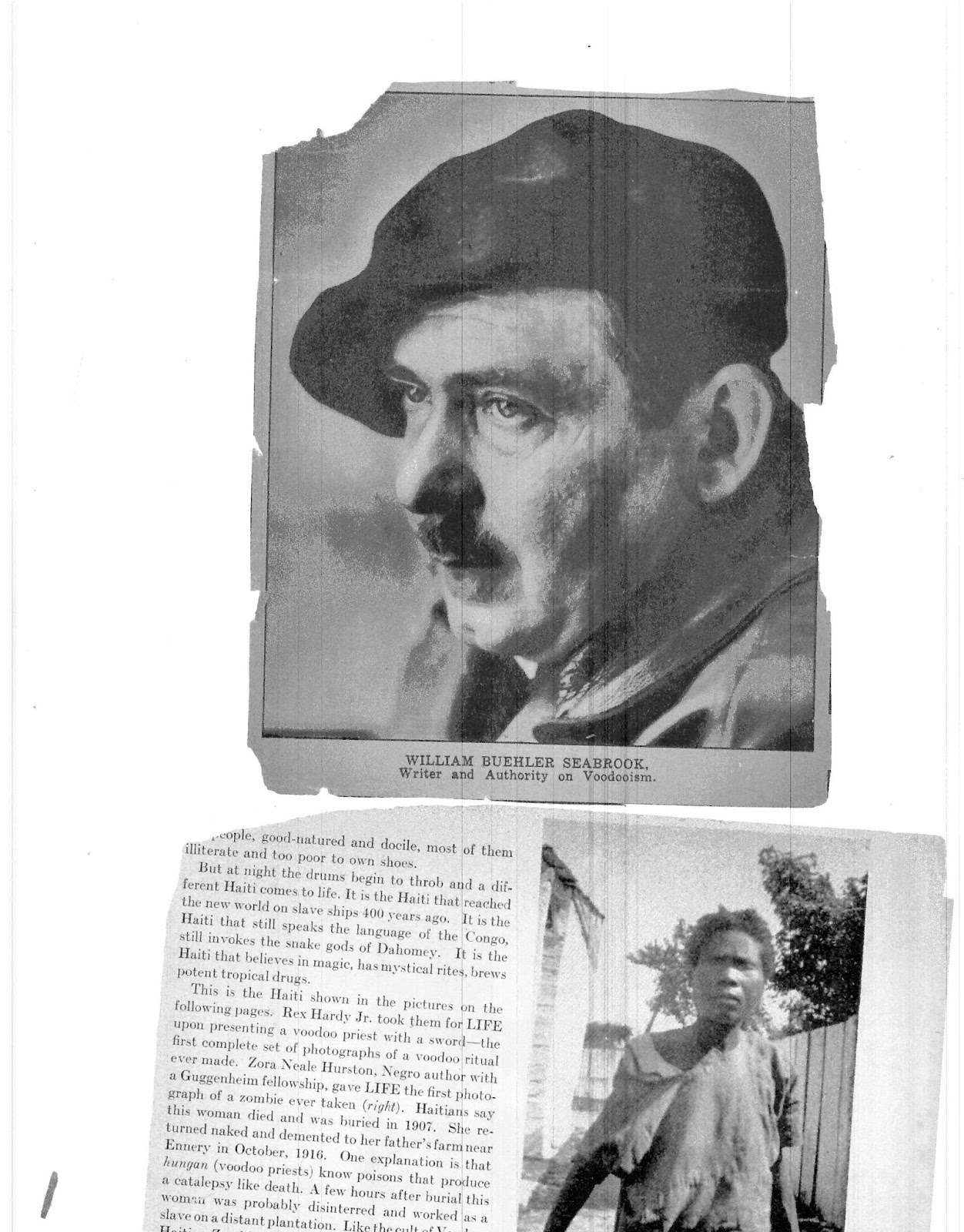
The Magic Island
William Buehler Seabrook (February 22, 1884 – September 20, 1945) was an American Lost Generation occultist, explorer, traveler, cannibal, and journalist, born in Westminster, Maryland. He began his career as a reporter and City Editor of the Augusta Chronicle in Georgia and later became a partner in an advertising agency in Atlanta.
Note from me: A series of newspaper and magazine(?) clippings were found in this book which were on the verge of disintegration, so I attempted to preserve them digitally:

Subscribe to:
Posts (Atom)
